So that your commitment turns into action.
About usTailored support at every stage.
Equality and Organizational ChangeAn organizational diagnosis is a strategic decision.
Participatory Gender AuditLearning differently to act differently.
Training and workshopsWhen your activity takes place in Indigenous territories, dialogue is not a formality, it is an alliance.
Just TransitionRaising awareness for sound governance.
ResearchEquality Equations · Equigual supports organizations in the world of work, in all sectors, in developing their potential as agents of workplace well-being, through change support that promotes dignity, research and strategic intercultural dialogue.
With an ILO-certified methodology and intersectional, participatory approaches, we co-create the tailored pathway, from diagnosis to the action plan, its implementation and capacity building.
Equality is not improvised, it is built.
Equigual's work draws on conceptual and methodological approaches from the social sciences, individual and collective human rights, and results-based project management, in order to ensure an inclusive co-creation process.
Alone we go faster, together we go further.
A gender perspective is a comprehensive, integrated strategy aimed at promoting equality between women and men across all areas, rather than treating gender as a separate or isolated issue.
It ensures that gender perspectives are built into decision-making processes, thereby promoting equitable outcomes and addressing structural inequalities.
Gender inequalities exist in every country and affect half of the world's population. That is why Equigual approaches the problem of inequality first from a gender perspective.
But stereotypes and discrimination become more complex when gender-based discrimination intertwines with others, such as socioeconomic level, access to education, gender identity, sexual and romantic orientation, migration background, mother tongue, religion, ethnic origin, disability, age, etc.
The intersectional approach makes it possible to integrate these different dimensions into the analysis of inequalities, so as to leave no one behind.
Any action undertaken must make sense to the people involved in order to achieve the desired impact. Taking cultural aspects into account helps strengthen the co-creation of knowledge and practices that respond to real needs (bottom-up).
From a facilitation stance, we adopt this approach, which requires flexibility and decentring, and draws on disciplines such as anthropology, human rights and decolonial critical thinking.
Benefits of the culturally relevant approach
Let's calculate your progress on the transformation scale.
Transformative approaches question the root causes of gender inequality and seek to truly correct the power dynamics and structures that reinforce inequalities (UNICEF, 2020 and Rutgers, 2021).
For an approach to be gender-transformative, it is not enough to promote the improvement of the situation of women and girls. Inequality between the sexes must be challenged by transforming harmful gender norms, roles and relations, and by redistributing decision-making power, resources and services more equitably.
We use UNDP's Gender Results Effectiveness Scale (GRES) to measure how organizations integrate equality into their activities, policies and programmes — and to define concrete, measurable equality indicators for transformation. See the full scale, always visible, below.
Feminist NGOs and international organizations such as UN Women have transformative goals. But not every organization needs to have this purpose: a car manufacturer can sit between "gender targeted" and "gender responsive" without failing its mission.
Benefits of transformative approaches
Equality is not improvised, it is built.
On equality issues, preparation is essential for measures to fulfil their purpose. Without the buy-in of the parties involved, they are unlikely to succeed.
We work with the A.D.K.A.R. method (Awareness, Desire, Knowledge, Ability, Reinforcement), adapted by the ILO International Training Centre (ITC-ILO) for equality. With collective intelligence and facilitation tools, we carry out participatory processes that strengthen the buy-in of the parties.
Benefits of the participatory collective intelligence approach

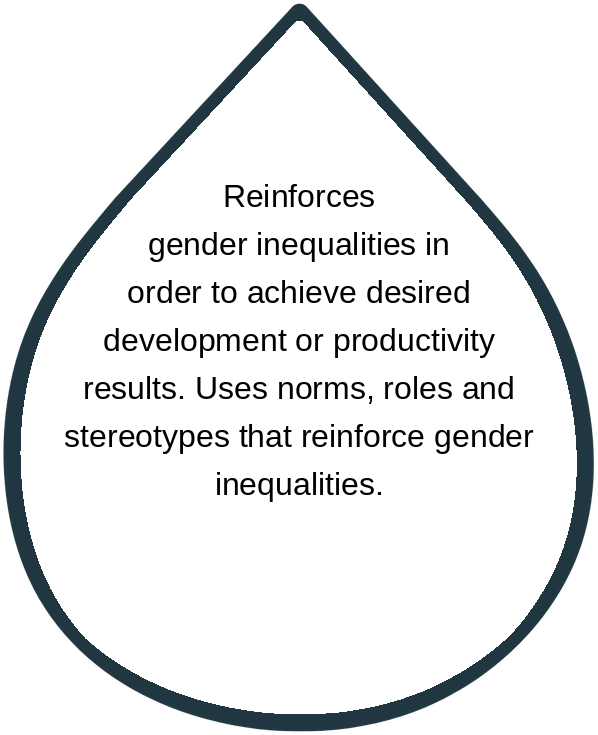
Reinforces gender inequalities in order to achieve desired development or productivity results. Uses norms, roles and stereotypes that reinforce gender inequalities.
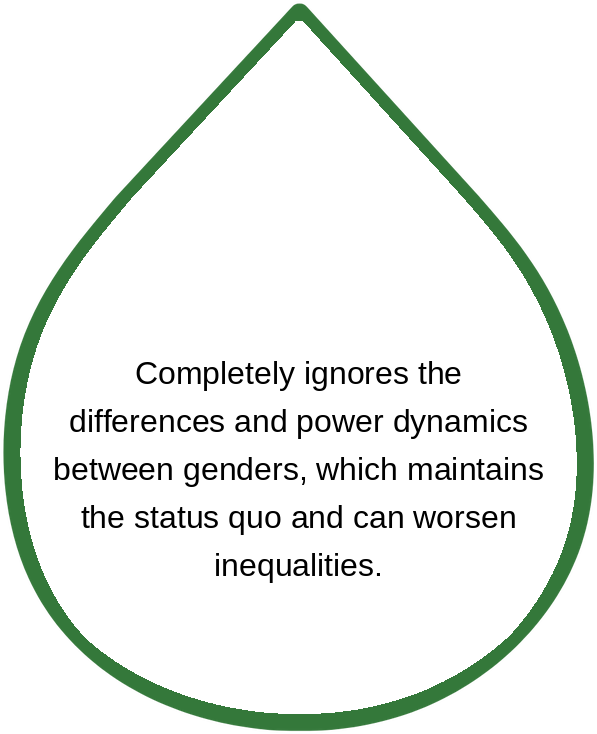
Completely ignores the differences and power dynamics between genders, which maintains the status quo and can worsen inequalities.
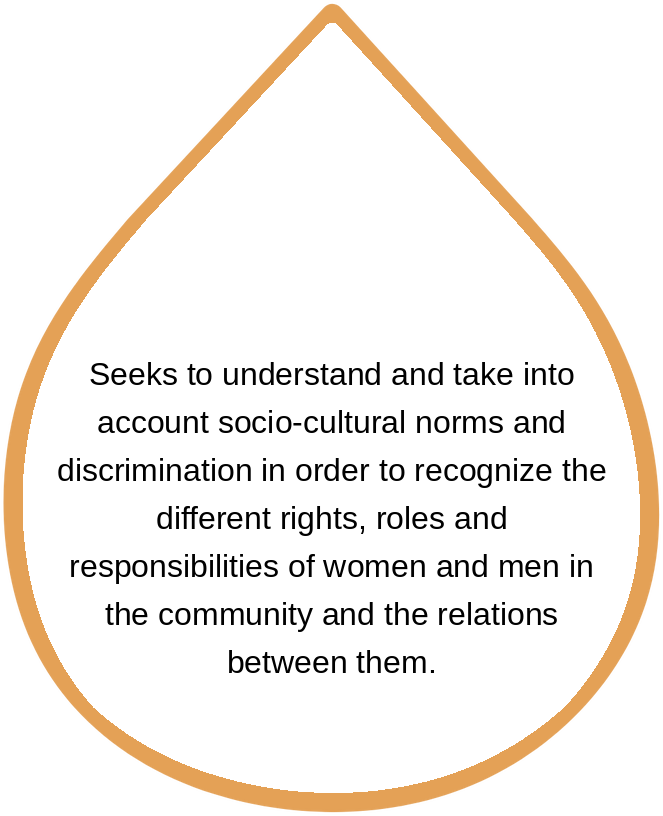
Seeks to understand and take into account socio-cultural norms and discrimination in order to recognize the different rights, roles and responsibilities of women and men in the community and the relations between them.
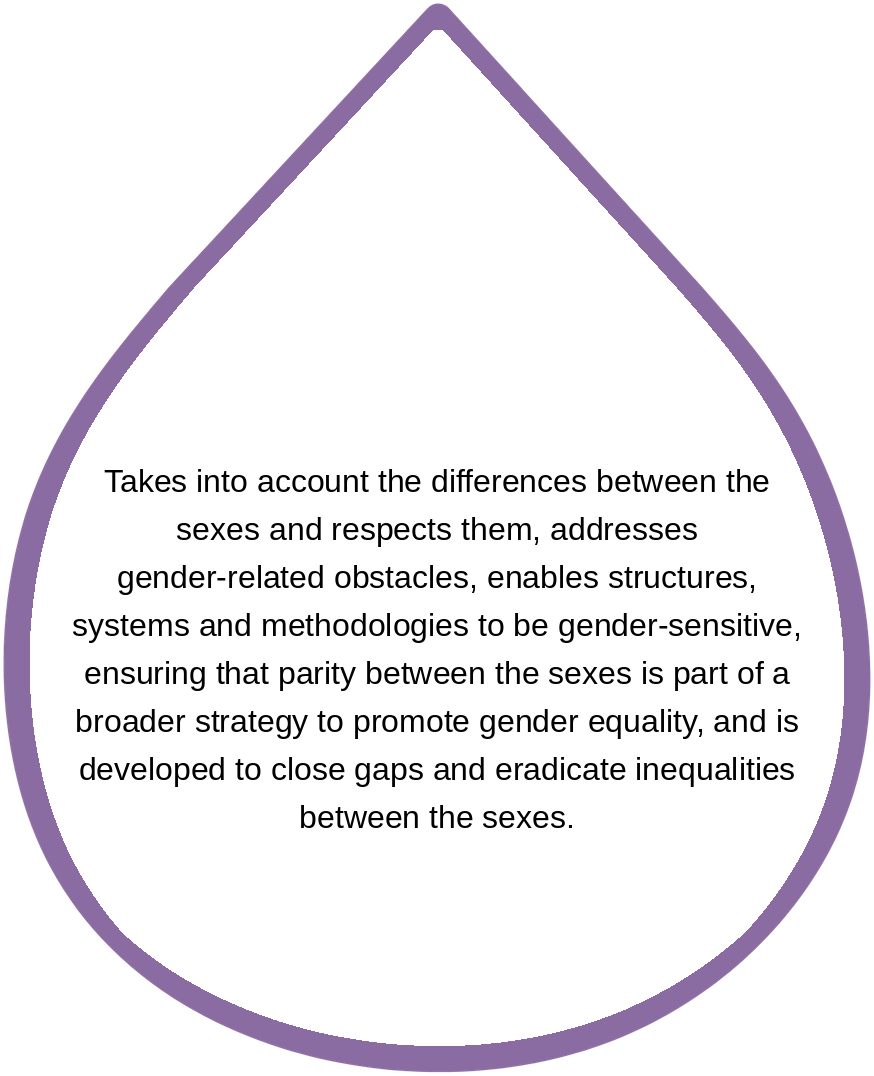
Takes into account the differences between the sexes and respects them, addresses gender-related obstacles, enables structures, systems and methodologies to be gender-sensitive, ensuring that parity between the sexes is part of a broader strategy to promote gender equality, and is developed to close gaps and eradicate inequalities between the sexes.
Actively seeks to change gender norms and social norms in order to remedy inequalities of power and privilege between people of different genders, with the aim of freeing everyone from harmful and destructive norms.
Hover over — or tap — each stage to see its description.
Three complementary programmes, adapted to the size and context of each organization.
Mission. To support organizations in all sectors so that they fulfil their potential as equality leaders in the workplace, through our 3 programmes: Research & Information Dissemination; Strategic support that promotes human dignity; Just Transition.
Vision. We aspire to a world in which organizations of all sectors and sizes fulfil their potential as agents of well-being for all that lives. Policymakers, business leaders and local stakeholders actively promote a culture of equality. Diversity is reflected in decision-making spaces.
Our values